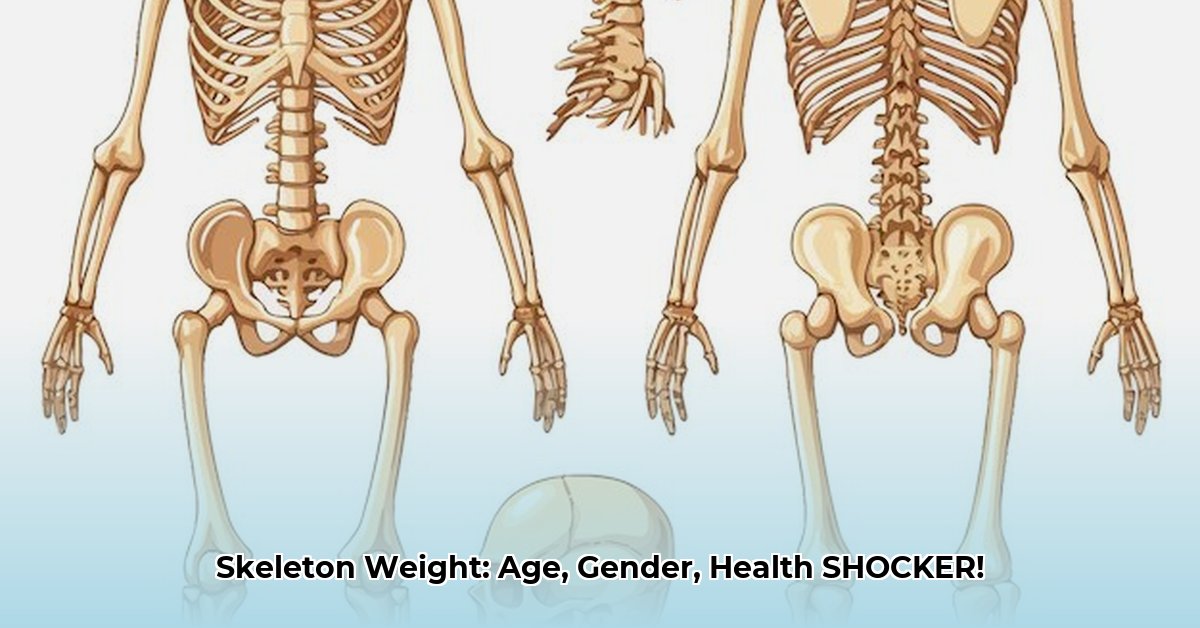
Is your skeleton really 15% of your body weight? That's a common belief, but it's often wide of the mark. This article explores the true complexities of human skeletal weight, looking at the factors that influence it and the limitations of different estimation methods. We'll delve into why a simple calculation is often inaccurate and examine more precise, albeit less accessible, techniques.
Factors Influencing Skeletal Weight
Several interconnected factors influence the weight of your skeleton. It's not a static number; it changes throughout your life.
Age: A Bone's Journey
Imagine your bones as trees, constantly growing and changing. During childhood and adolescence, they build mass rapidly, reaching peak density in young adulthood. After this point, bone density gradually decreases, impacting skeletal weight. An elderly person's skeleton will typically weigh less than that of a young adult.
Gender: A Significant Difference
Generally, men have heavier skeletons than women due to differences in bone density and overall skeletal structure, influenced by hormone levels and genetics. This is a critical consideration when estimating skeletal weight.
Body Composition: The Weight Connection
Your Body Mass Index (BMI), a measure of weight relative to height, plays a significant role. Higher BMI generally correlates with increased bone density and, consequently, a heavier skeleton. This reflects the body's adaptive response; greater weight demands stronger bones to support it.
Health Conditions: Bone Density Impacts
Various health conditions can influence bone density and therefore, skeletal weight. Osteoporosis, characterized by weakened bones, dramatically lowers skeletal mass. Other diseases or nutritional deficiencies can also indirectly affect bone health.
Methods of Skeletal Weight Estimation: A Comparison
Accurately determining your skeletal weight isn't as simple as stepping onto a scale. The 15% rule offers a convenient but often inaccurate approximation. More precise methods exist, each with its own limitations.
| Method | Description | Accuracy | Accessibility |
|---|---|---|---|
| The 15% Rule | Estimate skeletal weight as 15% of total body weight. | Low | Very Easy |
| DEXA Scan (Dual-energy X-ray Absorptiometry) | Uses low-dose X-rays to measure bone mineral density. | High | Requires specialized clinic visit |
| Complex Mathematical Models | Utilizes numerous factors (age, sex, body composition, etc.) for estimation. | Moderate to High | Limited (research-based, requires specific data) |
The 15% rule is a ballpark figure at best. While useful for a general idea, it shouldn't be relied upon for accurate estimations. DEXA scans offer higher accuracy but require a specialist visit. Complex mathematical models, while potentially more accurate, often necessitate detailed, and sometimes unavailable, individual data.
Addressing Discrepancies: Why Simple Isn't Always Sufficient
The significant variations between estimation methods highlight the inherent individuality of human biology. Simplifying this intricate interplay of factors leads to inaccuracy. Genetics, lifestyle, health conditions – all contribute to the unique composition of an individual's skeletal structure. A “one-size-fits-all” approach simply won't suffice.
Conclusion: Prioritize Bone Health, Not Just Weight Estimation
Estimating human skeletal weight accurately demands more than a simple calculation. Age, sex, body composition, and overall health all play crucial roles. The 15% rule provides a rough estimate, but precise measurements require advanced techniques. Consult a healthcare professional for any significant bone health concerns. They can provide personalised advice and implement appropriate assessments. Prioritize maintaining a healthy lifestyle to support strong, healthy bones. The precise number is less important than overall bone health.